The reviving Florentine neighborhood near Jaffa।
©Rina Castelnuovo for The New York TimesTel Aviv


©Rina Castelnuovo for The New York TimesPosted by apc produce design at 10:50 PM 0 comments
© www.telavivinf.com
Architect: Yitzchak Toledano
Posted by apc produce design at 10:48 PM 0 comments
הבית המשוגע הוא כינויו של בית מגורים משותף הנמצא ברחוב הירקון בתל אביב, קרוב לכיכר אתרים
הבניין תוכנן על ידי האדריכל ליאון גנייבה ובנייתו הסתיימה ב-1989
Posted by apc produce design at 11:57 PM 0 comments


Posted by apc produce design at 11:55 PM 0 comments
Kikar Levana is an environmental sculpture that sits atop a small hill, at the Edith Wolfson Park, in Tel Aviv. The sculpture’s name means White Square. It is located at the highest point in Tel Aviv where the city meets nearby Givatayim. The main entrance to the park is at the intersection of Ha’Tayasim Ave. and LaGuardia Street. The sculpture is located in a public park that is open all day. It is created by the Israeli sculptor Dani Karavan, who was born in Tel Aviv on December 7, 1930. He is the son of a landscape architect and he was a member of a kibbutz and he first studied in Israel. He continued his studies in Florence and in Paris.
Posted by apc produce design at 11:49 PM 0 comments
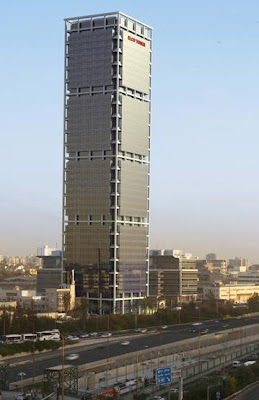
Moore Yasky Sivan Architects is the largest, most prestigious and experienced architecture firm in Israël. This project is located on Yigal Alon Street near Hashalom Interchange of the Ayalon Highway. Construction is planned to be completed in 2011.

Posted by ilovetlv at 11:48 PM 0 comments
.jpg)
.jpg)

Posted by apc produce design at 11:47 PM 0 comments
In Tel Aviv, a 42-story residential tower is in the works for a site on the exclusive Rothschild Boulevard. Designed by architecture firm Richard Meier & Partners Architects, the plan takes its cues from light, sea views, and the surrounding neighborhood.
Transparent materials will be employed throughout the structure, which includes a lobby and retail space complete with glass canopy facades on the ground level, a second floor pool and spa, and a tree-lined open plaza at the entrance, creating a screen for street traffic.
“The intention is to create a pure and simple iconic tower that will function as a new landmark for the city of Tel Aviv,” says Meier. Richard Meier (born October 12 , 1934) is a American architect known for his rationalist designs and the use of the color white. In 1984, Meier was awarded the prestigious Pritzker Prize.
The building will be developed by Berggruen Holdings. Construction is planned to be completed in 2012.
.jpg)

Posted by ilovetlv at 11:46 PM 0 comments
Posted by apc produce design at 11:45 PM 0 comments
Pourquoi toutes ces frontières
Qui donnent envie que l'on s'affronte
Je demande à la Terre
Pourquoi cette colère qui monte
Je n'ai pas signé pour saigner
Et voir pleuvoir dans mes songes
Que des larmes d'ange
J'avais envie de partir, mentir
De dire à mes souvenirs
"Laissez-moi perdre mémoire"
J'avais envie de partir, mentir
D'inventer la vérité
De rêver sans aspérités
J'ai vu tomber du ciel
Le soleil au fond des rivières
J'ai vu couper les ailes
A nos envolées de lumière
Pourquoi l'homme est comme
La nuit d'automne
Qui vole la vie aux jours
Et les fait plus courts
J'avais envie de partir, mentir
De dire à mes souvenirs
"Laissez-moi perdre mémoire"
J'avais envie de partir, mentir
D'inventer la vérité
De rêver sans aspérités
J'avais envie de partir, mentir
De trouver le sourire
D'un enfant qui voit le vent
J'avais envie de partir, mentir
D'inventer la vérité
De rêver sans aspérités
Pourtant j'invente
Et tu inventes avec moi
Cette pente à gravir
Sans gravité
Pourtant j'invente
Des lendemains qui se mentent
Qui nous chantent tout l'été
Ces seuls chants
J'avais envie de partir, mentir
De dire à mes souvenirs
"Laissez-moi perdre mémoire"
J'avais envie de partir, mentir
D'inventer la vérité
De rêver sans aspérités
J'avais envie de partir, mentir
De trouver le sourire
D'un enfant qui voit le vent
J'avais envie de partir, mentir
D'inventer la vérité
De rêver sans aspérités
Posted by apc produce design at 11:44 PM 0 comments


Posted by apc produce design at 11:42 PM 0 comments
Posted by apc produce design at 11:40 PM 0 comments
Posted by apc produce design at 11:38 PM 0 comments


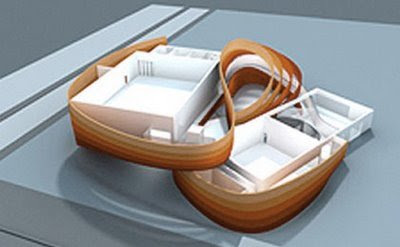
Interior view of design museum, rendering by Ron AradPosted by ilovetlv at 11:36 PM 0 comments

Posted by ilovetlv at 11:33 PM 0 comments
by Catherine Weill-Rochant
Tel Aviv, a paradox?
In this city of denuded concrete, where the unpleasantness of apparent ugliness always yields to the delights of a stroll, a delight that is more readily associated with more picturesque cities, the question that arises is how to account for this antinomy: how is it that Tel Aviv, such a decrepit city, so disparaged esthetically, can generate so much urbanity? How can a stroll by buildings with their loggias walled up with plastic shutters, facades elevated by hastily built additional stories, walls studded with the fans of air-conditioning units, stilt columns entombed in breeze block, still engender pleasant memories? This question presents even more sharply if one thinks on the contrary of the peculiar sensations of void experienced when touring old neighborhoods like the ones in Jaffa that were expensively renovated। Although entirely restored, repaved and spruced up, they generate no sensation, scant emotion, no sense of place. Here lies one of the crucial questions in city planning: what are the features that make for the ‘success’ of a city? This is probably the question all researchers in the field of urban history must grapple with. Through the study of spatial, social and architectural development, the goal is to find the keys to what make people like a city or hate it, by plunging into the process of its making. This analysis also calls for exploring the culture, the land, and the political situations that affected city growth. Tel Aviv is particularly suited for this type of study. First of all, it presents itself as a clearly identifiable corpus in time and space. It was founded as an independent entity, in 1909, on the dunes to the North-East of Jaffa and expanded during the Mandate period, spreading northwards up to the Yarkon River, westward to the sea, and eastward up to what is now the Ayalon highway. Secondly, this corpus is the result of both an interweaving of tensions with the local situation, and specific external ties: the city was imagined and built by groups of immigrants, vectors of architectural and urban thinking trained in Europe and driven by explicit societal planning on a land already carved up by conflicts. Lastly, Tel Aviv has been promoted and written about internationally, which facilitates an analysis of its image in the collective imagination and the disparities with historical reality revealed through scientific analysis. [...]
Read more : http://bcrfj.revues.org/index672.html
Vous pouvez consulter l’intégralité de ce dossier traduit en langue française sur le site du Centre de recherche français de Jérusalem : http://bcrfj.revues.org/document249.html
Deux ouvrages très intéressants de Catherine Weill-Rochant:
• L'Atlas de Tel-Aviv. 1908-2008
• Sur les traces du modernisme
Ce guide bilingue, français-hébreu, permet de découvrir, au fil de promenades commentées par des spécialistes, les trois plus importantes villes d’Israël : Tel Aviv, Haïfa et Jérusalem.
©Oleg ChermoshniukPosted by ilovetlv at 11:31 PM 0 comments

.jpg)
.jpg)
.jpg)
Posted by ilovetlv at 11:27 PM 0 comments